Tigris CRM
The internal CRM behind an advisory practice.
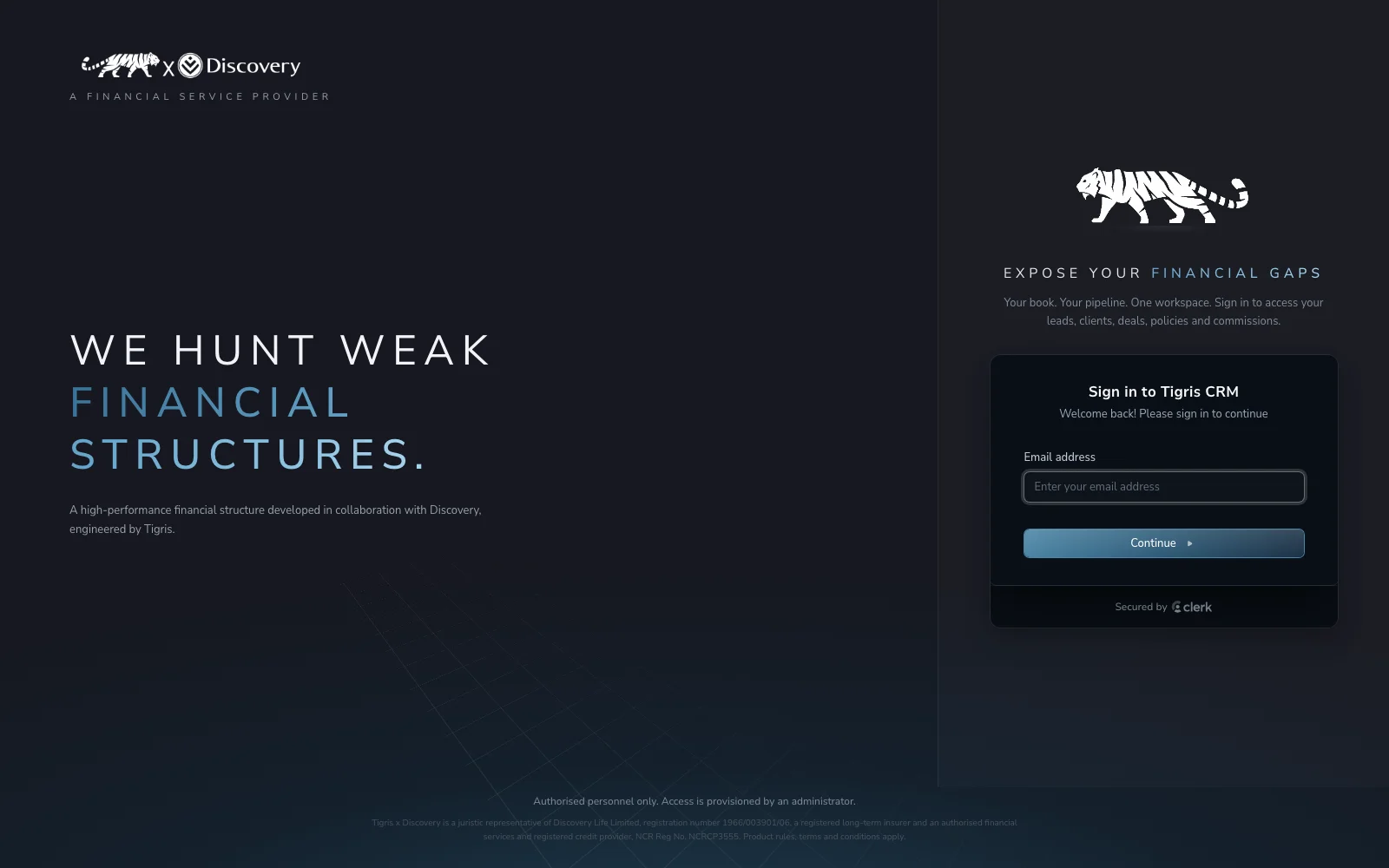
Tigris CRM is the internal system built to run the Tigris X Discovery advisory practice. Client records, leads, the advice pipeline, issued policies, commission statements, and compliance evidence live in one place instead of spread across spreadsheets, inboxes, and insurer portals.
An advisory business is not a sales funnel. A case moves from prospect to meeting, through quote and FICA, application and medicals, underwriting, and only then to issued. The documents that make each step legitimate have to exist before the next one opens. Tigris models those gates in the data rather than in a policy document: a case cannot reach application without an ID and proof of address, underwriting without the application itself, or issued without the acceptance letter. The server refuses the move and names what is missing.
The same discipline runs through the rest of it. Every mutating request writes an audit row with the actor and the role they held at the time. Roles are defined in the database rather than the code, so permissions and row-level scope can be reshaped without a deploy. Records outside a user's scope return a 404 rather than a 403, so the system never confirms the existence of something you are not allowed to see.
Cedar designed and built it end to end: the data model, the staged pipeline, commission reconciliation, and the compliance layer. Data residency stays in South Africa, with the database in Johannesburg, the application in Cape Town, and regulated documents in af-south-1.
The brief
An advisory practice runs on evidence: every case needs the right documents at the right stage, every issued policy needs its commission reconciled, and every client file needs a compliance review that can be produced on demand. Spread across spreadsheets, inboxes, and insurer portals, none of that is visible until something has already gone wrong.
What we built
Tigris CRM puts the whole practice into one system, covering leads, the staged advice pipeline, policies, commissions, and compliance. Stage gates hold a case until it is actually ready, and oversight reads across branches, business units, and advisor books.
What it does
Client and lead records
Every client, lead, and policy in one profile with its full history. An advisor's book is derived from the policies allocated to them rather than declared, so it can never disagree with what they are actually paid on.
Gated advice pipeline
Cases move from prospect through meeting, quote and FICA, application and medicals, and underwriting to issued. The server refuses a move whose documents are missing and names them, so the board and the record cannot drift apart.
Commission reconciliation
Insurer statements import per period, classify against per-insurer rules, and resolve to an advisor. Anything untyped, unmatched, or without an advisor surfaces for attention instead of quietly going missing.
Separated duties on payouts
Finance prepares a commission run, a director finalises it, and only a super admin can unlock a finalised one, with every unlock permanently recorded.
Compliance and audit trail
Consent, records of advice, data-subject requests, auditor scopes, and yearly FICA reviews per client, over an append-only log of every change with the actor and their role at the time.
Roles defined in the database
Capabilities, visible screens, and row-level scope are data, not code, so a new role is configured rather than deployed. Out-of-scope records return a 404, never a 403.
Practice reporting
Commission and lapse by period, pipeline value by stage, and per-advisor standings, readable firm-wide, by branch and business unit, or down to a single advisor's book.
How it works
Step 01
Capture and allocate the lead
New leads land unallocated and are assigned to a named advisor, branch, and business unit.
Step 02
Work the gated pipeline
The case advances only once its stage requirements are satisfied: identification, proof of address, application, medicals.
Step 03
Issue and reconcile
Issued policies carry into the premium book, and commission transactions are matched back to the advisor and the case.
Step 04
Prove compliance
FICA reviews, consent, and advice records stay attached to the client file, ready for audit rather than assembled after the fact.
Who it serves
Financial advisors
The people working cases, who need the client's full picture and a clear view of what each case is waiting on.
Practice principals
Owners and managers who need pipeline, commission, and lapse visibility across branches and business units.
Compliance and back office
The team producing FICA reviews, consent records, and data-subject responses on demand.
The outcome
A practice that ran on spreadsheets, inboxes, and insurer portals now has one model of itself: leads, cases, policies, commissions, and compliance evidence in the same system, with the process enforced by the software rather than by whoever remembers it.